
Low Thermal Scanners for DC Voltage and Resistance Standards
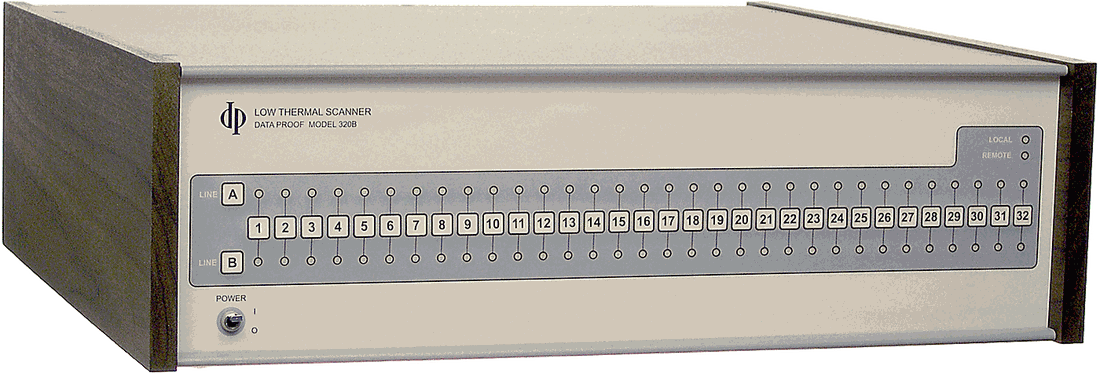
Data Proof scanners and software are used by hundreds of standards laboratories around the world to improve accuracy while saving labor. Built in the U.S. since 1983.
- Thermal offsets typically under 20 nV (under 15 nV with Option 4)Under 20 nV thermals
- 16 or 32 channels16 or 32 channels
- Front panel or IEEE-488 (GPIB) controlFront panel or GPIB
- VoltRef and OhmRef software for voltage and resistance standardsVoltRef & OhmRef software
For a quote, email info@dataproof.com or call (408) 919-1799.
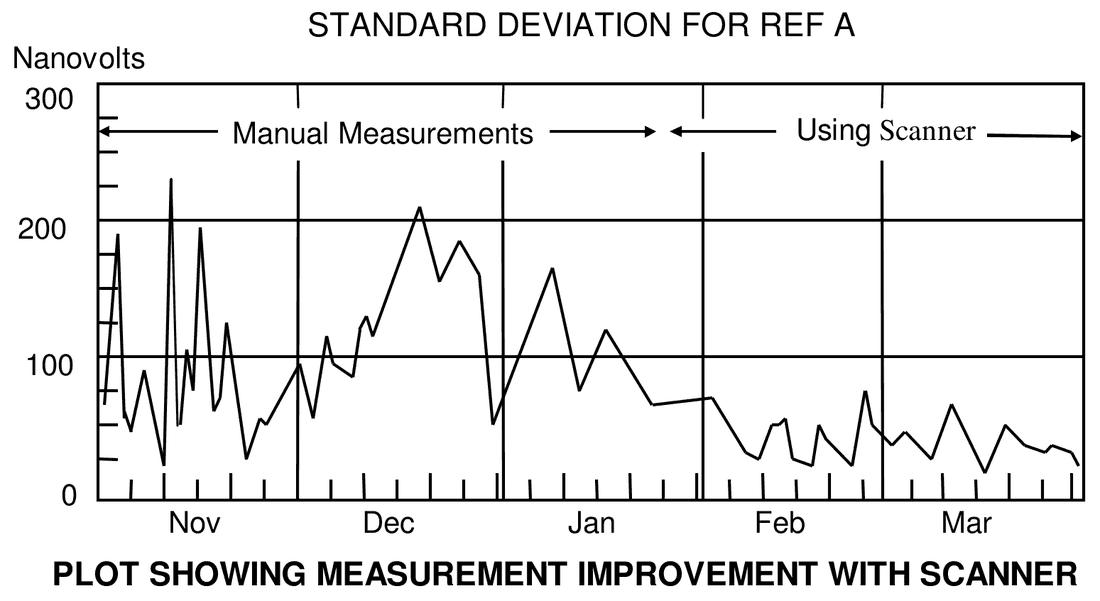
Measured by hand vs. with a scanner
Standard deviation of one voltage reference over five months. For three months the leads were moved by hand. Then a Low Thermal Scanner was installed and the leads were no longer handled.
From our Application Notes.
Products
160B / 320B Low Thermal Scanner
160B / 320B DatasheetChoose 16 channels (160B) or 32 channels (320B), then the input option that fits your work.
Cable Inputs
Six-foot solid copper cables
Our lowest cost option, and a popular choice for comparing voltage standards.
Binding Post Inputs
Gold-flashed binding posts
The most versatile. Use your own leads, replace them, or move the scanner and leave the leads.
Shielded Cable Inputs
Six-foot shielded Teflon cables
The choice for the lowest thermals, such as Josephson arrays or noisy environments.
Guarded Cable Inputs
Six-foot guarded cables
Built for resistance. Each channel has 4 leads plus high and low guards.
Option 5 DatasheetThermal offset: under 20 nV typical, 50 nV max. *Option 4: under 15 nV typical, 30 nV max.
Available in benchtop or rack-mount assemblies.
164B Quad Scanner
164B Datasheet16 four-terminal channels, built for use with a DCC resistance bridge. Available with low thermal binding posts only (Option 2). Thermal offset under 20 nV typical, 50 nV max.
Software
VoltRef and OhmRef drive your scanner and meter, so the whole comparison runs on its own and the leads never get handled.
VoltRef: Voltage Standards
VoltRef DatasheetMaintains your lab's volt for you. Compares up to 32 standards using the process NIST recommends, tracks their drift, and can run overnight while the lab is quiet.
OhmRef: Resistance Standards
OhmRef DatasheetMaintains your resistance standards the same way. Compares resistors from 100 Ω to 10 GΩ, better than 1 ppm from 1 Ω to 10 MΩ, and tracks their drift.
Both run on Windows 11, 10, 7 and XP, with an IEEE-488 (GPIB) interface card and a supported meter.
About Data Proof
Data Proof has designed and built Low Thermal Scanners and measurement software for standards laboratories since 1983.
Our scanners help maintain the volt in hundreds of laboratories around the world, including the national laboratories of nearly all industrialized nations.
Made in the USA
- 1983Data Proof is founded by Jim Marshall, a Hewlett-Packard standards laboratory engineer, after the National Bureau of Standards (now NIST) encouraged him to bring his low thermal scanner to market.
- 1990NIST fully automates its 10 V Josephson array voltage standard using a Data Proof scanner. NIST paper
- 1994OhmRef extends the method to resistance standards.
- 1999Data Proof and NIST publish the guarded scanner design in the Review of Scientific Instruments.
- TodayScanners in use worldwide, with about a third going to customers outside the U.S.
Downloads
Datasheets
Application notes and support
- Application NotesAutomated systems for measuring voltage, resistance and temperature with uncertainties below 1 ppm.
- Programming TipsOperating Data Proof scanners over the IEEE-488 bus.
- Software Instrument DriversMeters and sources supported by VoltRef and OhmRef.
- LabVIEW Driver (ZIP)Driver and documentation for National Instruments LabVIEW. Works with all Data Proof scanners.
References
- Improvements for Automating Voltage Calibrations Using a 10-V Josephson ArrayRichard L. Steiner and Robert J. Astalos (NIST). IEEE Transactions on Instrumentation and Measurement, Vol. 40, No. 2, April 1991. NIST's automated Josephson array system, built with a Data Proof scanner.
- Design and Evaluation of a Low Thermal Electromotive Force Guarded Scanner for Resistance MeasurementsDean G. Jarrett, James A. Marshall, Thomas A. Marshall and Ronald F. Dziuba (NIST and Data Proof). Review of Scientific Instruments, Vol. 70, No. 6, June 1999.
- NBS Technical Note 430: Designs for Surveillance of the Volt Maintained by a Small Group of Saturated Standard CellsW. G. Eicke and J. M. Cameron. National Bureau of Standards (now NIST), 1967. The measurement designs VoltRef is based on.
Manuals ship with each scanner and software purchase.
Contact
For a quote, tell us the model, the number of channels and the input option you need. For a technical question, tell us what you're measuring. For the quickest response to inquiries and quotes, send us an email.